Readings and Applets for PHY
3400
Readings
in blue are required reading.
Introduction
- Mathematical Primer for PHY 3400 (PDF)
General sites
on light and color
History
- Reading:
Some Readings in the History of Optics (PDF)
(Encyclopedia
Britannica) - A History of Measurements
of the Velocity of Light (PDF)
(Encyclopedia
Britannica)
General properties
of waves: interference, superposition, polarization
- Appletshowing transverse and longitudinal waves. Note that every
point in the medium moves up and down (transverse) or back and forth (longitudinal)
around its initial position.
- Applet
showing wave interference from two waves moving in opposite directions.
You can adjust the types of waves that interact. Turn on the "notes" feature
as you try out different kinds of waves.
- Applet showing reflection of wave with both fixed end and free end. It also show the resulting standing wave.
- Transverse standing wave applet.
You can adjust the number of nodes (a node is an interior point that does
not move).
- Longitudinal standing wave applet.
You can adjust the number of nodes (a node is an interior point that does
not move).
- Standing wave applet for a stretched
sheet. This applet shows that a sheet can also undergo oscillations and
waves (a drumhead, for example).
- Polarization
applet from the FSU site. You can adjust the angle of polarization
of the filters. Start off with both filters at 0 degrees, then try chaning
the angles and see if you understand what is going on.
Physical nature
of light
An interesting applet
showing how electromagnetic waves are composed of oscillating transverse
electric and magnetic fields. - Glennbrook South High
School Physics has several interesting areas for light and electromagnetic
phenomena, including short units on the visible
spectrum and polarization.
Also check out the short
discussion on why we think that light is a wave.
- Blackbody
radiation applet from the FSU site. Heat the jug and watch the colors
change with temperature. Why do you see color changes?
- Relativistic
Optics, see what would happen if we can change the speed of light.
Color
- An applet
showing additive primaries and the rgb color scheme used by monitors,
televisions, etc. It demonstrates quite effectively how, by choosing shades
of each primary color (r,g,b), one can generate millions of colors.
- Several applets demonstrating
additive and subtractive primaries. One applet allows you to choose shades
of subtractive primaries, demonstrating how color printing can yield an
enormous number of colors from only 3 subtractive primaries.
- Color
separation applet. This simple applet from the FSU site demonstrates
vividly the four color printing process and CMYK color separations.
- Here's
a simple
exercise on painting a person in a football uniform using CMYK subtractive
colors, though the K part is left out. You will need Shockwave for
this exercise. Try it and see if you can guess the resulting colors
by trying CMY combinations.
- Here's
a simple site with a useful
summary of the color concepts we learned in class.
- Glennbrook South High School Physics has
several interesting areas for color. Please do the exercises listed for
the units on color
addition and color
subtraction.
Colorimetry
- This
page has several applets
on color and many links to color measurement and color theory sites. These
are described below
- The
spectrum
applet allows you to draw a 16 point spectrum and generate the (x,y,z)
coordinates of the spectrum as you draw it.
- The
chromaticity
and gamut applet allows you to draw a color gamut triangle within the
CIE color curve and get the coordinates of any point within the gamut.
- The
color space
and conversion applet allows you to find colors in (r,g,b) space, where
the space is represented as a cube, with each of the three colors forming
a side.
- The
color matching
game applet tests your skill at matching colors
- This applet allows
you to view colors using a color tree diagram very similar to the Munsel
color system.
Vision
- Some Readings about Color Vision (PDF)
(Encyclopedia Britannica) - Eye (Compton's Online Encyclopedia) (PDF)
- Some Readings about the Eye (PDF)
(Encyclopedia Britannica) - Prof. Avery's notes about the eye (PDF)
- Berkeley lecture on human vision and how
color is used to convey information (color,
B&W)
- Eye
and Retina (PDF)
(Course at Washington University)
- "The Joy of Visual Perception: A Web Book".
This is an extremely useful reference with lots of pictures and explanatory
material.
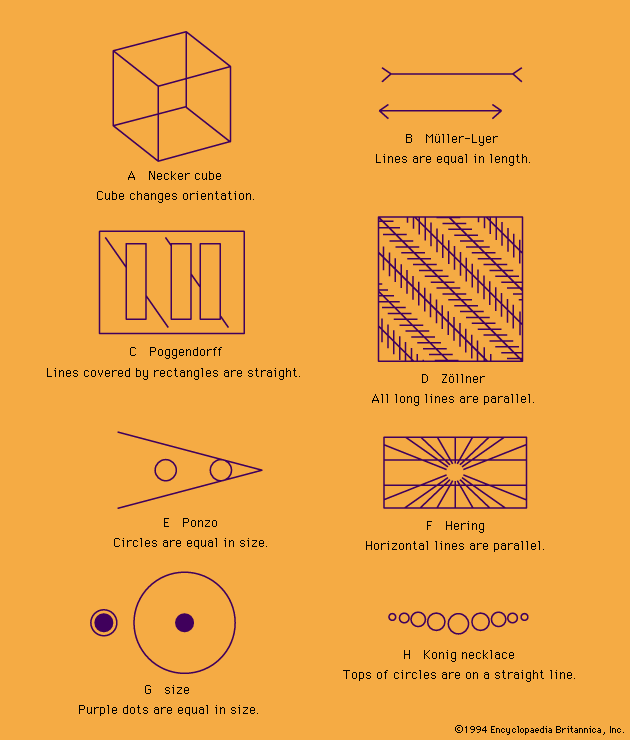
Optical illusions
Optics (chapter
6)
- This applet demonsrates
refraction at a plane boundary between two media. You can adjust the index
of refraction and the angle of incidence.
- Another
applet
demonstrating reflection and refraction at a plane boundary.
- This wonderful optics
applet lets you play with mirrors and lenses. You can move the object
or change the focal length by clicking and dragging. The interesting and
more realistic case of non-paraxial light rays is also shown.
- This
applet
also demonstrates spherical aberration in a real thick lens. You can vary
the radius of curvature of each side of the lens and adjust the index
of refraction of the lens material.
Optical devices
(chapter 7)
Interference
- Applet demonstrating
two slit interference. You can change the wavelength, the slit separation
and the distance of the slits from the screen.
- This
applet
demonstrates wave interference with a simulated ripple tank.
- This applet
gives a different view of two slit interference.
Atmospheric
effects
- Very well done rainbow applet,
showing how the primary and secondary rays get bent inside the raindrop
as the position of the incoming ray changes.
- Here is a somewhat simpler rainbow
applet
- This site
has a detailed discussion of rainbows and related optical phenomena, including
several pictures and diagrams.
- Long list of mirages collected
from around the world.
- Science page explaining
scattering, blue skies and other atmospheric effects.
- A well
done site for all kinds of Atmospheric effects.
Holography